Article by John Hughes
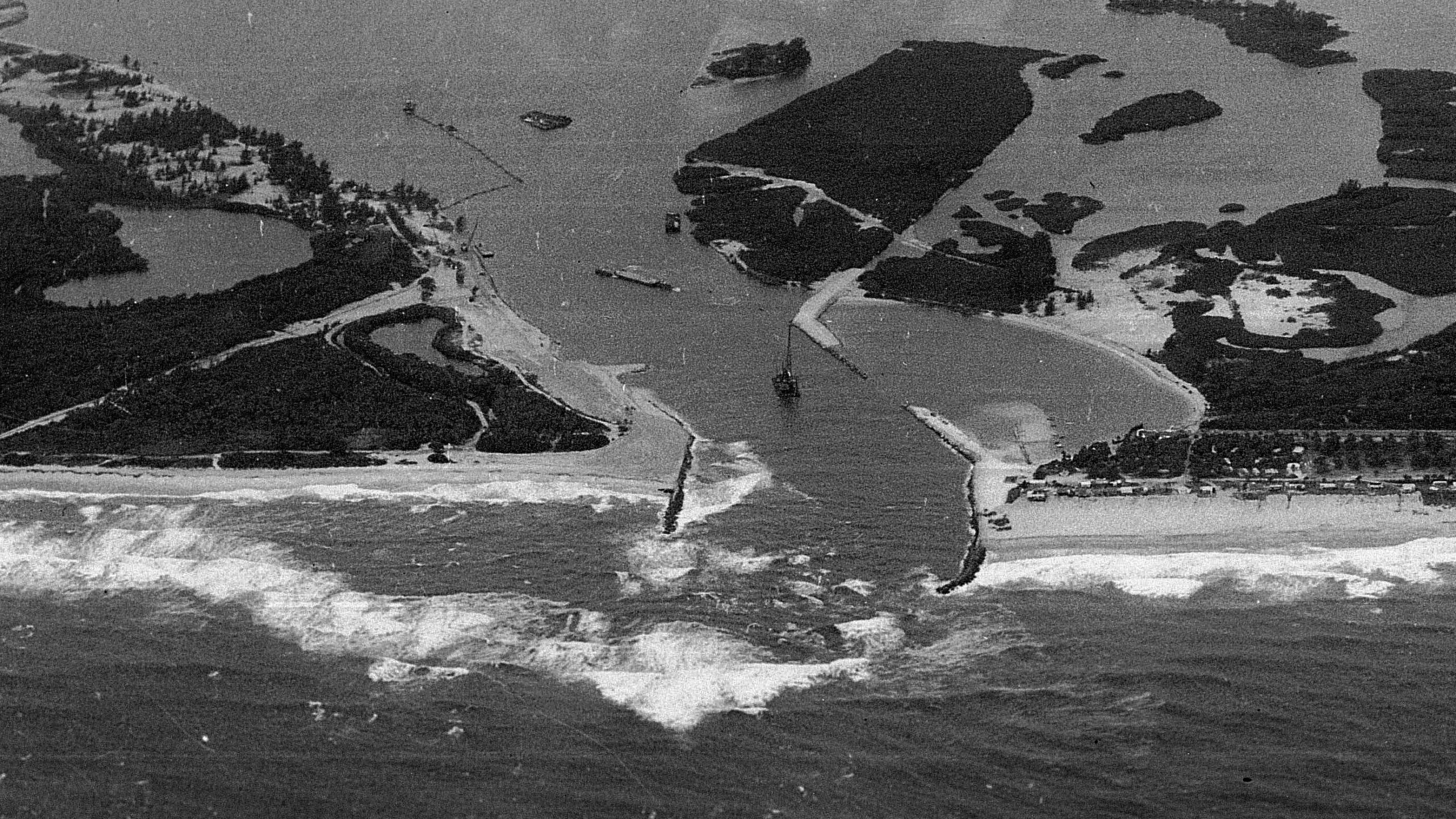
“It was impossible to paddle out at any of the beaches. A tremendous storm had stalled in the Atlantic 300 miles east of the Central Florida Coastline. Waves were pounding the beaches and coming over the tops of the piers from Daytona to Palm Beach.
Richard Allen Catri and I were on one of our frequent surfing safaris from Miami. Local Indialantic surfers told us about a spot called Sebastian Inlet 14 miles to the south where waves broke inside the inlet, waves so huge that large fishing boats didn’t go out.
Of course, Dick and I had to check it out. It was 1959, six years before the bridge was built. At the end of A1A was a fishing village of old trailers and tents and a Bait and Beer shack. That was it, except for rows of waves inside the inlet where the tide was pouring out to sea…. (as told by Jack Murphy).”
The tale of who first rode the waves of Sebastian inlet is one of Florida surf culture’s origin stories, the stuff of legend, acted out by two of surfing’s most influential and colorful characters, Dick Catri and Jack “Murf the surf” Murphy. The two became friends in 1950s Miami where their infatuation with surfing brought them together and they soon began their adventures (and misadventures) living the surfing life.
That day at Sebastian Inlet, in 1959, was the true beginning of the larger-than-life stories of their colorful lives- Catri, who single-handedly bent the history of East Coast surfing to his vision; and Murf, who began as one of the earliest East Coast surfing stars and quickly fell from grace, following a life of crime and murder before eventually finding redemption.
Any great surf story begins with a spoken tale told from one surfer to another. The Duke, Duke Kahanamoku, and his mile-long bluebird wave at Waikiki, Greg Noll’s discovery of the famous big wave break of Waimea are two famous examples. The story is told and retold and it begins to get embellished with details. Other details are edited out. Personal biases start to creep in and the story sometimes evolves into something else by the time it makes it to the printed word in your favorite surf magazine or newspaper article. The core truth is still there, but the details get smudged. Yes, the Duke surfed a mile long wave at Waikiki, but his ancestors probably did the same hundreds of years earlier. Greg Noll was the first to bring fame to Waimea but he didn’t paddle out alone and, again, native Hawaiians were there long before him. .
In an interview with Dick Catri in the Florida Today newspaper from 1979*, The article gives details about the group who traveled with them from Miami to explore the area’s waves.
“The original group included Catri, then 22; Hank Majors, who returned to Miami and became a fireman after extinguishing his wanderlust; Bill and Dudley Whitman, sons of the candy sampler family, and a happy-go-lucky sort named Jack Murphy.There was another surfer in the area at the time: Hal Higgenwald (correct spelling is Hegenwald Ed.)…but that was it. All those waves and no one else to share them with”.

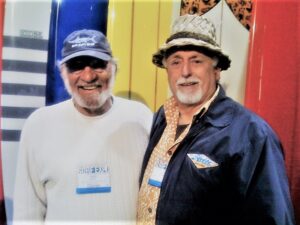
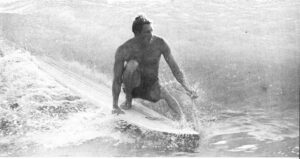
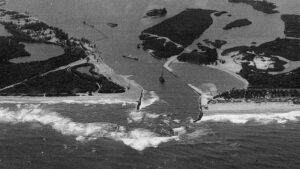
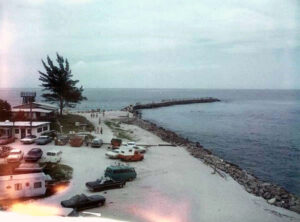
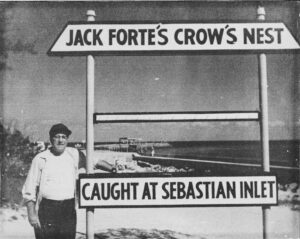
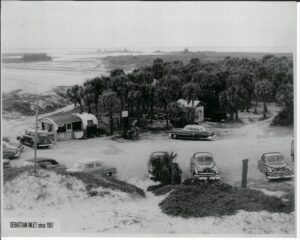
And so, it is probably true that Dick and Murf surfed the Inlet in 1959 and were the first to tell the story to the world. But there is more to the story. The tell is a line from Murf’s version of the adventure. So, in Murf’s account, which was shared with me in 2018 via e-mail correspondence, there were local surfers who already knew about the waves at the inlet and had probably surfed there before them. Yet, Dick’s account from 1979 claims there were no other surfers around back then. So, which version of the tale is the factual one? It appears that Dick and Murf over the years may have edited out or added some details to suit their purposes. As the saying goes- never let the facts get in the way of a good story.
So, there it is- the tale of two legendary Florida surfers that rode Sebastian Inlet for the first time. The details may have been a little stretched and hazy from being told and retold over the years, but the basic legend is intact; or is it? You see, there was this guy named Tom Lawton…
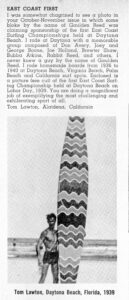
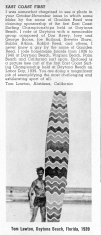
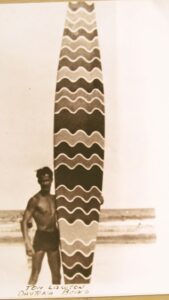
One of the benefits of having a surf museum is that we have a large collection of surfing magazines we can use as research. (You can see some of the publication we have put on line here). I was flipping through an early Surfer magazine from 1962, while looking at some of the Letters to the Editor, when I noticed a small photo of a man holding a Blake style hollow board from the 1930s. His name was Tom Lawton and he said, among other things, that he had surfed with a group of some of the earliest surfers in Daytona Beach and had participated in the 1939 Florida State Championships held there, which was the first surf contest ever held in Florida. It was pretty interesting, so I scanned it and saved it in my hard drive, for possible use later.
Several years later, I was working on a project to scan all the issues of Surf Magazine, a publication by Mike Mann that appeared in the 1970s and ran for nine issues. Much to my surprise, while again flipping through the letters to the editor, there was a letter from Tom Lawton, with the same photo, 15 years later. Part of the letter reads,
“….For many years I was the only surfer south of Daytona Beach. It was very lonely. Everybody thought I was crazy, and I am. Sebastian Inlet on Sunday, November 28th was the best spot I surfed. I only disliked ducking those weighted Mullet Snaggers. I remember taking the big board in the picture out to that reef on the south side of the inlet in 8’ to 10’ storm surf in 1939. I rode waves a city block while my girlfriend sat on the beach…”
So, the first surfer to ride Sebastian Inlet wasn’t Dick Catri and Jack Murphy. It was ridden 20 years earlier by Tom Lawton.
In 2024 I was able to get in contact by phone with Lawton’s surviving son, Jay Lawton. According to Jay, Tom led a restless life in his earlier years, moving from North Carolina to Florida, including Daytona Beach then West Palm Beach. Jay has no recollection of when Tom started surfing, but he was already an accomplished surfer by the time he moved to Florida.
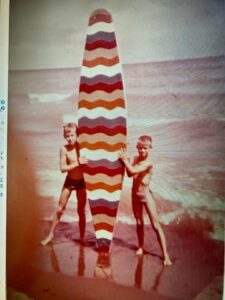
Lawton’s restlessness led him to move often, to Pittsburg, Ohio and eventually to Grimsby Beach, Canada next to Lake Ontario. Not long afterwards he built a small surfboard for his two sons, Jay and Scott to ride what passed for surf on the lake. Jay recounts,
“We didn’t really understand why he had to be near the water, but he was an old surfer. We lived right across from the lake. He designed a surfboard to build down in the basement of the house. He built this thing, ordered special parts for the nose and the tail. And we built this whole surfboard, and then we painted it that squiggly, uh, kind of, a candy cane (design)up and down, and that’s the same thing, same design he used when he ordered a big longboard. We didn’t understand what he was doing, but I have a picture of my brother, Scot, and I holding that board with Lake Ontario in the background and we were like, and you know, 11 and 13 years old. I mean, there’s no surfing on Lake Ontario, it’s just slop, you know, but we were probably the only people, humans to ever try to surf Lake Ontario”
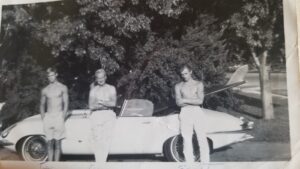
In 1960 or 1961 Tom moved the family to California to be closer to the surf. Both Scott and Ray became avid surfers and Tom got back into surfing as well. However, Tom’s restlessness continued and he traveled back and forth from California and Florida. In 1990, according to Ray,
“..when he was in Florida, he needed to have a gallbladder removal, and of course he asked us permission. We said sure. So, what he did, was he, uh, he had this old Ford Falcon with a surfboard on the top with surf racks, so he pulls up to the hospital there. I think it was in West Palm Beach. so, he pulled up to go to the hospital. He figured, well, I’ll have my operation, and then I’ll recuperate a day or two, then I’ll go surfing, and basically what happened, was he never came out of the hospital. And what he did was; he was a pretty ornery guy. And when you ever get an operation, you know, they have drain tubes coming out of you and stuff, and he got really pissed off and ripped them out. And of course, you can’t do that. He got sepsis, right? So, he got sepsis, and basically, that’s what killed him. And he left his car sitting there with the surfboard on top.”
Tom was cremated, as he wanted, and the family spread his ashes at his favorite spot, First Point Malibu.
So that’s the story of who was the first to surf Sebastian Inlet. The history of the inlet states that the channel was stabilized in 1924 when a small jetty was completed. That is a period of 15 years before 1939 that Tom Lawton made his claim. Surfing in Florida has been documented as early as 1909. So, was Tom Lawton really the first? Stay tuned…
* Florida Today- Sunday, May 20, 1979

Leave A Comment